
Balance Exercises for Seniors
As we age, maintaining balance becomes increasingly vital for preserving independence and quality of life. Falls are the leading cause of injury-related hospitalizations among seniors, with 1 in 4 older adults experiencing a fall each year, according to the CDC. The good news? Balance is a skill that can be improved at any age. Regular balance exercises strengthen the muscles, sharpen coordination, and boost confidence in daily movements—whether it’s walking the dog, climbing stairs, or standing up from a chair. This guide provides safe, effective balance exercises tailored for seniors, along with tips to reduce fall risks and stay active for years to come.
Why Balance Training Matters for Seniors
Balance relies on a complex interplay of three systems:
- Vision: Helps orient the body in space.
- Vestibular System (Inner Ear): Controls equilibrium.
- Proprioception: The body’s ability to sense movement and position.
Aging often weakens these systems, but targeted exercises can counteract declines by:
- Strengthening leg and core muscles, which stabilize the body.
- Improving reaction time to prevent stumbling.
- Enhancing neural pathways that coordinate movement.
- Reducing fear of falling, which often leads to inactivity.
Studies show that seniors who practice balance exercises 2–3x weekly reduce their fall risk by 27% (British Journal of Sports Medicine).
Safety First: Guidelines for Balance Training
Before starting:
- Consult your doctor, especially if you have osteoporosis, vertigo, or a history of falls.
- Use support: Stand near a wall, sturdy chair, or countertop.
- Wear non-slip shoes and avoid loose clothing.
- Start slow: Begin with seated exercises if standing feels unsteady.
- Breathe: Never hold your breath during movements.
10 Effective Balance Exercises for Seniors
1. Heel-to-Toe Walk
Why: Mimics natural walking patterns while challenging stability.
How:
- Stand near a wall or countertop for support.
- Place one foot directly in front of the other, heel to toe.
- Take 10–15 steps forward, then backward.Modification: Hold onto a caregiver’s arm for added safety.
2. Single-Leg Stance
Why: Strengthens ankles and improves proprioception.
How:
- Hold onto a chair back with both hands.
- Lift one foot slightly off the floor, balancing on the standing leg.
- Hold for 10–15 seconds; switch legs.Progress: Try balancing with one hand or no hands.
3. Sit-to-Stand
Why: Builds leg strength for daily transitions.
How:
- Sit in a sturdy chair, feet flat on the floor.
- Lean slightly forward, push through your heels, and stand up slowly.
- Lower back down with control. Repeat 8–12x.Modification: Add a cushion to the chair to increase difficulty.
4. Side Leg Raises
Why: Targets hip abductors, critical for lateral stability.
How:
- Hold onto a chair back.
- Lift one leg out to the side, keeping toes pointed forward.
- Lower slowly. Do 10 reps per side.Tip: Avoid leaning your torso; keep shoulders over hips.
5. Marching in Place
Why: Improves coordination and dynamic balance.
How:
- Stand tall, holding a countertop if needed.
- Lift one knee toward your chest, then lower.
- Alternate legs for 20–30 seconds.Progress: Add arm swings or close your eyes briefly.
6. Backward Walking
Why: Challenges balance systems differently than forward walking.
How:
- Stand near a wall or walkway with ample space.
- Take small, controlled steps backward for 10–15 feet.Safety: Have a caregiver spot you initially.
7. Tai Chi “Wave Hands Like Clouds”
Why: Tai Chi is proven to enhance balance and reduce falls.
How:
- Stand with feet shoulder-width apart, knees slightly bent.
- Shift weight to the right leg while sweeping arms to the right.
- Shift weight left and sweep arms left. Continue for 1–2 minutes.
8. Toe Taps
Why: Enhances reaction time and ankle mobility.
How:
- Sit in a chair, feet flat.
- Rapidly tap your toes on the floor for 30 seconds.
- Rest and repeat.
9. Standing Hip Circles
Why: Lubricates hip joints and improves core engagement.
How:
- Hold onto a chair back.
- Lift one knee slightly and make small circles with your hip.
- Do 5 circles clockwise and counterclockwise per leg.
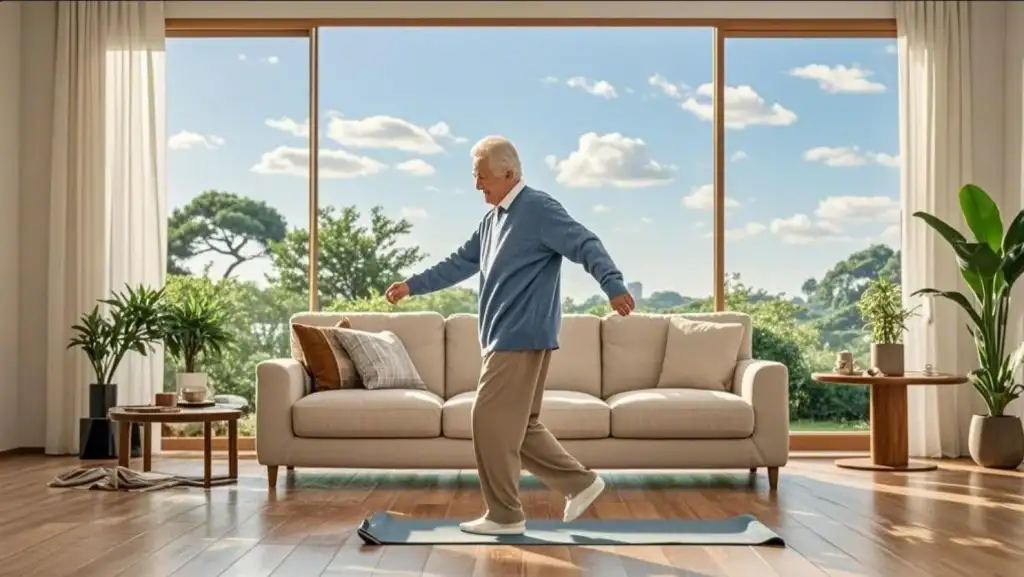
10. Tightrope Walk
Why: Sharpens focus and dynamic balance.
How:
- Imagine walking on a tightrope along a straight line on the floor.
- Place one foot directly in front of the other, arms out to the sides.
- Walk 10–15 steps, then turn around.
Balance-Boosting Tools
Incorporate props to add variety and challenge:
- Balance Discs: Inflatable cushions for seated or standing exercises.
- Resistance Bands: For leg lifts and lateral walks.
- Foam Pads: Create an unstable surface to mimic uneven terrain.
Sample Weekly Balance Routine
Monday:
- Heel-to-Toe Walk (5 minutes)
- Sit-to-Stand (3 sets of 10 reps)
- Tai Chi “Wave Hands” (5 minutes)
Wednesday:
- Single-Leg Stance (30 seconds per leg)
- Side Leg Raises (2 sets of 10 per side)
- Toe Taps (3 sets of 30 seconds)
Friday:
- Marching in Place (3 minutes)
- Standing Hip Circles (2 minutes per leg)
- Tightrope Walk (5 minutes)
Daily Bonus: Practice standing on one leg while brushing your teeth.
Lifestyle Tips to Reduce Fall Risks
- Home Safety: Remove tripping hazards (rugs, cords), add nightlights, and install grab bars in bathrooms.
- Footwear: Choose shoes with non-skid soles and avoid loose slippers.
- Vision Checks: Update eyeglass prescriptions annually.
- Stay Hydrated: Dehydration can cause dizziness.
- Review Medications: Some drugs (e.g., blood pressure meds) affect balance.
Nutrition for Balance and Bone Health
- Calcium & Vitamin D: Dairy, leafy greens, or supplements to support bone density.
- Protein: 1.0–1.2g/kg of body weight to maintain muscle mass (e.g., fish, beans).
- Omega-3s: Fatty fish or flaxseeds to reduce inflammation and support brain health.

Case Study: Regaining Confidence After a Fall
Background: Margaret, 72, avoided walks after fracturing her wrist in a fall.
Plan:
- Weeks 1–4: Seated balance exercises (toe taps, leg extensions) + chair yoga.
- Weeks 5–8: Added standing exercises with a caregiver’s support.
- Weeks 9–12: Joined a Tai Chi class and practiced heel-to-toe walks daily.Results: Margaret regained confidence, resumed gardening, and hasn’t fallen in 18 months.
FAQs
Q: How often should seniors do balance exercises?
A: Aim for 20–30 minutes, 2–3x weekly. Daily practice (even 5 minutes) is ideal.
Q: Can balance exercises help with vertigo?
A: Yes! Vestibular rehabilitation exercises (e.g., Brandt-Daroff maneuvers) can reduce dizziness. Consult a physical therapist.
Q: What if I can’t stand without support?
A: Start seated. Chair-based exercises still improve core strength and circulation.
Q: Are group classes better than solo practice?
A: Classes add social motivation, but home exercises work too. Choose what’s sustainable.
Conclusion
Balance exercises are a simple yet powerful tool for seniors to stay active, independent, and injury-free. By dedicating just 10–15 minutes daily to movements like heel-to-toe walks, single-leg stands, and Tai Chi, older adults can strengthen their bodies, sharpen their minds, and reclaim their confidence. Remember, progress—not perfection—is the goal. Start where you are, celebrate small victories, and embrace the journey toward a steadier, more vibrant life. Your balance is your independence; nurture it with every step.


