If you're new to fitness or healthy eating, you may have heard the term "counting macros." This approach to nutrition involves tracking macronutrients—protein, carbohydrates, and fats—to help you achieve your health and fitness goals. Whether you're trying to lose weight, build muscle, or maintain your current physique, understanding how to count macros can give you greater control over your diet. This guide will walk you through everything you need to know to get started.
What Are Macros?
Macros, short for macronutrients, are the three main nutrient categories your body needs in large amounts for energy and overall function:
- Protein: Essential for muscle repair, growth, and overall body maintenance.
- Carbohydrates: Your body's primary energy source, fueling your workouts and daily activities.
- Fats: Vital for hormone regulation, nutrient absorption, and long-term energy storage.
Each macronutrient provides a specific number of calories per gram:
- Protein: 4 calories per gram
- Carbohydrates: 4 calories per gram
- Fats: 9 calories per gram
By tracking these three macronutrients, you can customize your diet to fit your goals and ensure a balanced intake of essential nutrients.
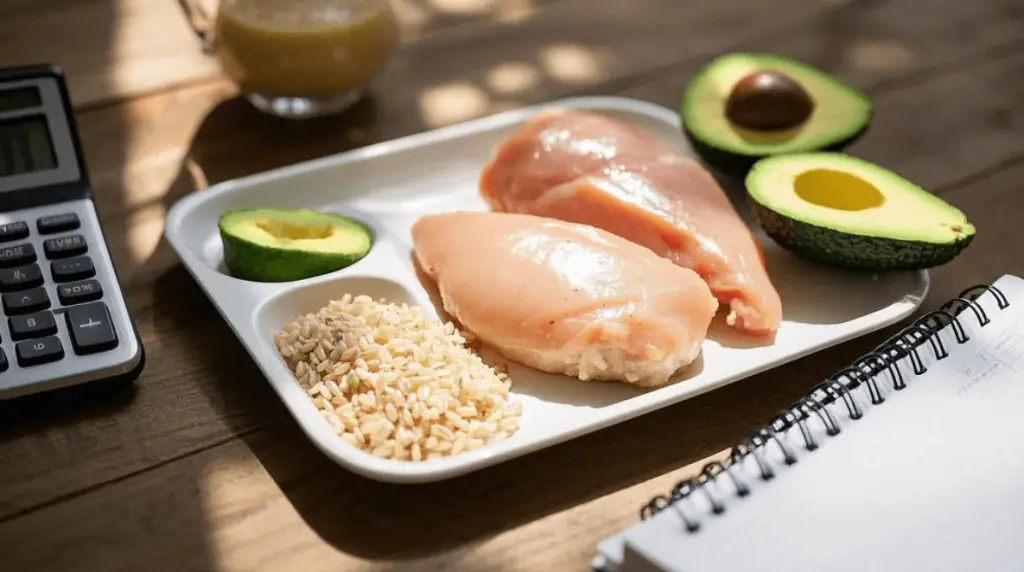
Why Count Macros?
Counting macros offers several advantages over traditional calorie counting:
- More Precise Nutrition: It ensures you get the right balance of protein, carbs, and fats.
- Flexibility: You can enjoy a variety of foods while staying within your macro targets.
- Improved Performance: Proper macronutrient ratios can enhance athletic performance and recovery.
- Customized Approach: Tailor your diet to specific goals like fat loss, muscle gain, or maintenance.
Step 1: Determine Your Caloric Needs
Your first step in counting macros is calculating how many calories your body needs each day. This depends on several factors:
- Age
- Gender
- Weight
- Height
- Activity level
Use the Mifflin-St Jeor Equation to estimate your Basal Metabolic Rate (BMR):
- Men: BMR = 10 × weight (kg) + 6.25 × height (cm) – 5 × age (years) + 5
- Women: BMR = 10 × weight (kg) + 6.25 × height (cm) – 5 × age (years) – 161
Next, multiply your BMR by an activity factor:
- Sedentary (little or no exercise): BMR × 1.2
- Lightly active (light exercise/sports 1-3 days/week): BMR × 1.375
- Moderately active (moderate exercise/sports 3-5 days/week): BMR × 1.55
- Very active (hard exercise/sports 6-7 days a week): BMR × 1.725
- Super active (very hard exercise/physical job & exercise 2x/day): BMR × 1.9
This calculation gives you your Total Daily Energy Expenditure (TDEE)—the calories you burn daily.
Step 2: Set Your Macro Ratios
Your macro split depends on your fitness goals. Here are common macro ratios:
- Weight Loss: 40% protein, 30% fats, 30% carbs
- Muscle Gain: 40% carbs, 30% protein, 30% fats
- Maintenance: 33% protein, 33% carbs, 33% fats
Example Calculation: If your TDEE is 2,000 calories and you want to lose weight with a 40/30/30 split:
- Protein: 40% of 2,000 = 800 calories ÷ 4 = 200g
- Fats: 30% of 2,000 = 600 calories ÷ 9 = 67g
- Carbs: 30% of 2,000 = 600 calories ÷ 4 = 150g
Step 3: Track Your Food Intake
To count macros accurately, you need to track what you eat. Here are the best ways to do it:
- Use a Food Scale: Weighing your food ensures precision.
- Read Nutrition Labels: Pay attention to serving sizes and macro content.
- Use a Tracking App: Apps like MyFitnessPal, Cronometer, or MacroFactor can simplify tracking.
Pro Tip: Plan your meals in advance to ensure you meet your macro targets.
Step 4: Adjust as Needed
Your initial macro targets may need tweaking. Monitor your progress and adjust your macros if:
- Weight Loss Plateau: Decrease calories or increase activity.
- Not Gaining Muscle: Increase protein and total calories.
- Low Energy Levels: Add more carbohydrates.
Common Challenges and How to Overcome Them
- Time-Consuming: Batch-cook meals to save time.
- Eating Out: Look for nutrition info online or estimate portions.
- Hitting Protein Goals: Incorporate lean meats, protein powders, and dairy.
Sample Macro-Friendly Meal Plan
Goal: 2,000 Calories (40/30/30 Split)
- Breakfast: 3 scrambled eggs, avocado, whole-grain toast (30g protein, 25g fat, 40g carbs)
- Lunch: Grilled chicken breast, quinoa, steamed broccoli (45g protein, 10g fat, 50g carbs)
- Snack: Greek yogurt with almonds (20g protein, 15g fat, 15g carbs)
- Dinner: Salmon fillet, sweet potato, sautéed spinach (40g protein, 20g fat, 45g carbs)

Final Thoughts
Counting macros may seem complicated at first, but with practice, it becomes easier and more intuitive. By understanding your body’s needs and tracking your intake, you can optimize your nutrition to meet your weight loss, muscle gain, or maintenance goals. Stick with it, stay consistent, and enjoy the flexibility and control that counting macros provides.


